Summary of the research and development of online inspection equipment for gypsum board
Published: 2026-06-25 17:53:11
Return to list
I. Background
During the production of gypsum board, various factors such as equipment, processes, and raw materials often result in a variety of defective products, including surface defects, uneven width, uneven thickness, and non-perpendicular edges. These defects seriously affect product quality and corporate reputation. Currently, the detection of these defects in the market is generally done manually. However, due to the influence of environment, fatigue, and emotions, the quality of the detection cannot be guaranteed.
Through more than seven years of repeated on-site testing and continuous research and development, Xi'an Huode has leveraged its own technological advantages and integrated advanced technologies such as artificial intelligence, machine vision, structured light, embedded control, laser, network, automatic control, and database technology. By striving to overcome many unfavorable conditions in gypsum board production sites, such as high temperatures, heavy dust, high production line speeds, and complex and variable processes, they have developed a complete set of online gypsum board quality testing equipment, which effectively solves the aforementioned problems.
Based on the "Action Plan for Intelligent Manufacturing and Digital Transformation of the Building Materials Industry (2021-2023)" issued by the General Office of the Ministry of Industry and Information Technology, Xi'an Huode has delved into production lines, broken through key core technologies, and created cutting-edge technologies. The system enables real-time online quality inspection of the production process, truly solving a major pain point in product quality control in the gypsum board industry for many years. It has improved and stabilized product quality, saved labor costs, obtained first-hand data on the production process, and solved the most critical underlying support for digital factories and intelligent manufacturing, completing the "last mile" of informatization and laying a solid foundation for the establishment of intelligent manufacturing and digital factories in the gypsum board industry.
?
II. Research and Development Process
1. Initial Development
Starting in March 2018, we at Beixin Xinxiang Gypsum Board Factory continuously developed the following equipment. This process lasted for 5 years until 2022. We call the entire equipment version 1.0.
(1)Mobile width detection deviceUltimately, due to the site conditions and the fact that the mobile structure could not guarantee the required precision for long-term operation, it was dismantled.
(2)Fixed width detection deviceWe pioneered the development of this device, which reliably and stably solved the problem of width detection and is still in use today.
(3)Upper and lower paper hole detection deviceUtilizing our expertise in machine vision technology, we successfully completed the paper surface defect detection, and this device has been in normal use ever since. However, due to the supplier's later improvements in paper quality, subsequent gypsum board manufacturers no longer adopted it.
(4)Vertical edge detection deviceOur pioneering use of "machine vision" 3D measurement technology to detect and display the upright edges of the board has been in normal working order ever since. Sometimes, dust may not be cleaned in time, causing the camera lens to become blurry and unable to take measurements. Other times, impacts from malfunctioning buns may cause the device to shift and prevent measurement.
(5)Automatic edge control deviceThis device was originally intended to achieve closed-loop control of the vertical edge, but due to the complexity of the site conditions and the numerous factors affecting the vertical edge, controlling the clamp alone could not achieve the goal of controlling the vertical edge. Therefore, this device has not been successfully applied and is still under continuous development.
(6)Panel Defect Detection DeviceThis device requires high-precision (0.05mm) detection of defects such as unevenness, bubbles, wrinkles, and grout leakage across the entire board surface. It involves large-format (including swinging up to 1.5 meters wide) and high-speed (up to 120 meters/minute) 3D measurement, for which no mature solution currently exists. After numerous discussions and practical experiments, we innovatively adopted a single-line structured light + area array camera + proprietary 3D algorithm to perfectly solve this problem. This device is currently operating stably and is still in use. However, the development process was fraught with challenges, especially the design, heat dissipation, dust prevention, and stabilization of the multi-line laser structured light device, which underwent repeated iterations. Other issues included board surface vibration, dust effects, and optimization of the installation structure.
(7)Double-plate defect detection deviceThis device is similar to the one described above, but it is twice the size of the one described above.
(8)Inkjet marking deviceIn order to ultimately eliminate defective boards, they must be marked. Initially, we used an inkjet marking device, which basically solved this problem.
(9)Identification and rejection devicesUsing a machine vision device, early inkjet markings are automatically identified, and a signal is sent to the PLC controlling the production line to reject defective boards.
(10)?Online thickness detection deviceIt innovatively employs laser technology for automatic detection of board thickness, thus improving board size measurement.
(11)?wedge edge measuring deviceUsing machine vision and laser technology, the width and depth of the wedge edge can be measured automatically in real time.
(12) Supporting server and application.
2. Continuous improvement
Starting in August 2022, based on version 1.0, we gradually began designing and manufacturing equipment at the Tianjin, Jinggangshan, Fuping, and Gucheng plants under Beijing New Building Materials Group. These four sets of equipment constitute version 2.0. We also further explored and developed some new online testing devices, as well as optimized and improved some of the version 1.0 devices. This process continued until 2024.
(1)Tianjin and JinggangshanAs one of the two pilot factories of Beijing New Building Materials Group (BNBM), it is equipped with a full-function testing system. However, due to the severe outbreak of the epidemic during the equipment processing, many supporting tasks were not in place, and some equipment processing was repeated, which delayed the progress of the project.
① Thickness measuring deviceBased on version 1.0, the thickness measurement system has been further improved, taking into account the effects of power supply and temperature, adding a dust removal function, a high-precision near-light sensor, and addressing signal loss and interference issues during long-distance transmission.
② Panel Defect Detection DeviceThe main improvement was replacing single-line lasers with multi-line lasers, which increased response speed and monitoring accuracy. However, there was no standard product for this laser, and its development was fraught with difficulties. Engineering challenges such as electrical cooling, heat dissipation, dust prevention, and impact protection were overcome, leading to numerous revisions. Now, this device is operating stably in various locations.
③ Code reading deviceWhile the inkjet system in Xinxiang could solve the marking problem, it added an extra inkjet unit, consuming more ink and increasing costs. The Tianjin 2.0 solution completely eliminated the Xinxiang inkjet marking system, replacing it with a "machine vision" method that automatically reads the existing time stamps on the board (code reader). This perfectly solves the problem of board positioning during marking and rejection. This device is constantly running, but inaccurate code reading can still occur due to inadequate maintenance and dust accumulation.
④ ?Temperature and humidity measurement inside the heating furnaceThe online monitoring of temperature and humidity inside the heating furnace has solved the problem of real-time online monitoring of temperature and humidity inside the heating furnace under high temperature conditions. This set of equipment has been in continuous use.
⑤ Bubble diameter detection deviceWe have developed a digital detection system for gypsum board foam diameter using machine vision technology, providing an effective means to improve foaming quality. For details, please refer to "Digital Detection System Solution for Gypsum Board Foam Diameter (Promotional) v2.1".
⑥ Dynamic monitoring device for interlayer evaporation in dryerThe surface temperature of the gypsum board is detected using a non-contact infrared thermal imager, which monitors the temperature of the gypsum board exiting the dryer. Continuous monitoring allows for prediction of the oven temperature. We designed and manufactured a specialized device and software for this system and conducted on-site testing. However, due to the installation location, it did not achieve the expected results.
(2) Fuping, Gucheng, only some of the testing devices were installed according to the customer's needs.
① Fuping,Dynamic weighing device for dry platesWe pioneered a dynamic weighing device in the gypsum board industry, solving the problem of automatic detection of single-unit weight indicators for gypsum board. The testing results are excellent, and this device has been operating stably to this day. Please see the "Fuping Gypsum Board Weighing Test Report 9.17-18-1" for details.
② Fuping,Online diagonal dimension measuring deviceUtilizing machine vision technology, we designed and manufactured the first online diagonal dimension measurement device in the gypsum board industry. This verified the correctness of the principle and provided an in-depth analysis of the relationship between accuracy, error, and the movement of the board material. Currently, this system still needs further development and its accuracy needs to be improved to meet production requirements.
(3) Yichang. It is a subsidiary of Taishan Gypsum.
① ?3D cameraThis is the first time that a 3D camera has been used to measure the wedge edge, width, and vertical edge. Although the cost is higher, the system is simpler, more stable, and easier to install; it has been running normally ever since.
② Automatic slurry area detection deviceThe machine vision method is used to detect the slurry area and output a signal to the control PLC.
(4) In the above 5 factories, many process problems were solved, such as the matching and rejection of short-board products, different rejection lines, automatic switching of QR code recognition, inkjet printing recognition, and we also learned more about process scenarios.
3. Pursue Excellence
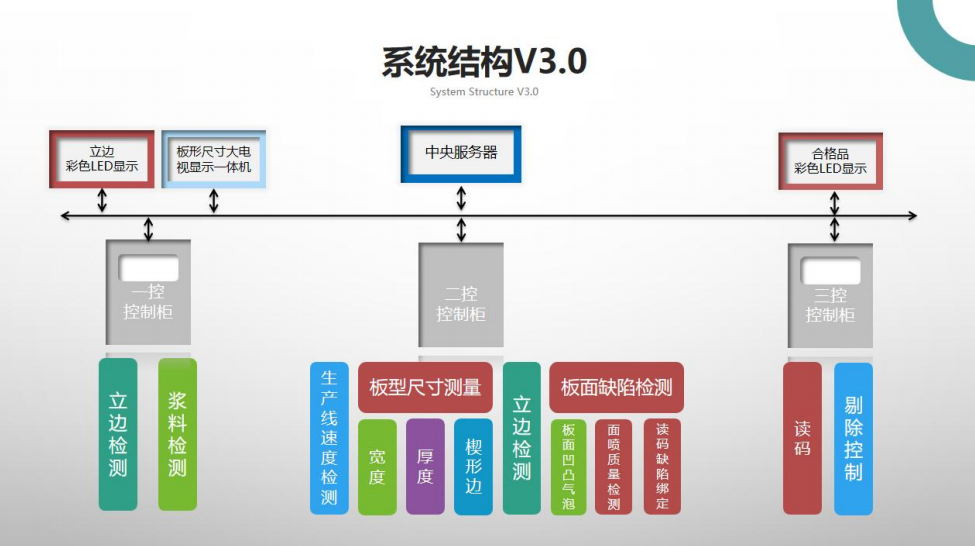
Starting in August 2023, we conducted a comprehensive discussion and review of version 2.0. By integrating all functions of the two-controller system into one, further improving and refining the one-controller and three-controller equipment, and enhancing server functionality, we significantly simplified on-site modification and installation, streamlined operation, enhanced reliability, reduced maintenance work, and further improved equipment standardization. Therefore, we officially launched version 3.0. For an introduction to version 3.0, please refer to "Gypsum Board Appearance Quality Inspection System V3.0".
4. Some Reflections
(1) The gypsum board industry is a niche industry, with only about 100 production lines nationwide. Large manufacturers lack the motivation to invest manpower and resources in in-depth research and exploration in the field of automatic inspection. However, due to market forces, some small companies have made some attempts. But faced with the harsh production environment of gypsum board, such as high temperature, low temperature, dust, mud, vibration, impact, high-speed movement, etc., as well as the many requirements of comprehensive technologies, such as machine vision, laser, artificial intelligence, database, etc., many small factories have only scratched the surface, some have given up halfway, and some have failed miserably.
(2) Xi'an Huode, by chance, entered this industry. Since 2018, we have spent more than 7 years pioneering the design and development of more than 22 types of online detection devices in this industry. We have invested more than 5 million yuan of our own funds, spending a lot of manpower and resources, and working with our customers to continuously explore and solve problems encountered, and continuously improve and perfect them. This process has been really arduous and long! Of course, our huge investment has naturally made us a leading provider of complete sets of technologies and equipment in this industry nationwide, and we have naturally stood at the forefront of automatic detection in this industry. Of course, technology has no limits. Compared with similar products abroad, we still have a lot of work to do, such as moisture content measurement, high-precision plate length detection, etc.
(3) The development of products requires continuous iteration, sustained investment, and strong user support to achieve perfection and stability. Moreover, the gypsum board industry involves more than twenty types of testing devices and technologies, making user support particularly crucial. Currently, we are the only manufacturer in the domestic gypsum board industry capable of providing complete sets of online testing equipment. We hope to continue to receive strong support from our customers in the gypsum board industry, enabling us to continuously launch new testing equipment, iterate continuously, and contribute to the construction of digital factories in the gypsum board industry.
?
III. Main problems solved and features introduced in version 3.0
1. Automation of dimensional measurement: Fully automated measurement of basic dimensions such as vertical edges, wedge edges, width, and thickness.
2. Automation of defect detection: Automated measurement of appearance defects such as dents, wrinkles, ink leakage, bubbles, and printing defects on the board surface.
3. Automatic report generation: Automatically generate reports such as output, yield, scrap rate, and defective board classification statistics.
4. Digitalization of the production process: Automated inspection in gypsum board production lines is the most critical foundation and solid basis for digital factories and intelligent manufacturing of gypsum board.
5. For a detailed description of the functions, please refer to "Gypsum Board Appearance Quality Inspection V3.0".
?
IV. Investment and Return Calculation
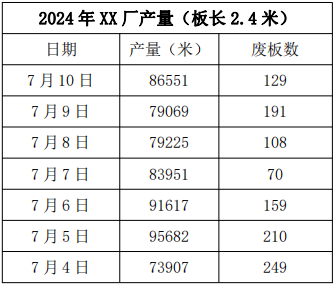
1. The table below shows the weekly output statistics of Factory XX. On average, it produces approximately 35,000 standard 2.4-meter boards per day. Each board sells for 28 yuan, resulting in a daily output value of 980,000 yuan. Assuming 300 days per year, the output value is approximately 294 million yuan. The cost per meter of standard board is roughly 3.5 yuan, with labor, materials, and energy each accounting for one-third.
2. Using this system, which comprehensively considers measuring thickness, width, vertical edge angle, wedge edge, board surface defects, automatic rejection, and report generation, it is estimated that one person can be reduced, and three people can be reduced in a three-shift operation. With an average cost of 100,000 yuan per person, the annual savings would be 300,000 yuan.
3. The main function of this equipment is to monitor the quality of the gypsum board production process, primarily by real-time monitoring of board dimensions and appearance defects. Once a defect is detected, an alarm is triggered promptly, prompting manual intervention. This reduces the risk of escalation, decreases waste, reduces energy consumption, increases yield, and improves efficiency. This requires data from a period of time (e.g., 1-2 months) where the equipment and system are not used. However, a rough estimate can be obtained by analyzing the number of defective boards eliminated and the number of consecutive failures.
(1) If a defect is detected, the board is not put into the drying oven; instead, it is directly dehumidified, saving energy; 200 sheets
(2) Timely alarm reporting reduces the escalation of accidents, and reduces the number of defective boards generated per day by 400.
In total, this translates to annual energy savings of 300 days x 600 sheets x 10/6 = 300,000 yuan.
4. Defective boards are eliminated to ensure quality and prevent them from entering the market. The resulting goodwill value is incalculable.
?
V. Comparative Advantages of German Products and Other Similar Products
LIMAB: A Swedish company founded in 1979, dedicated to the research and development of measurement systems for the gypsum board industry. Several factories in China use its systems, but due to the well-known high prices and untimely delivery and service issues associated with foreign brands, widespread adoption is difficult. However, its dimensional measurement system and online moisture content detection system are highly distinctive and worthy of our study and research.
Online message